

Jon Ryan Jensen: A Christmas Eve Creation retelling
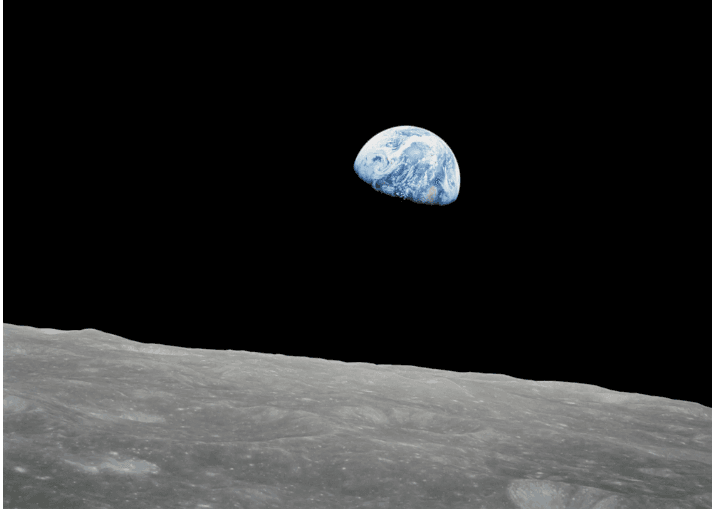
As part of this year’s Tabernacle Choir and Orchestra Christmas concert in the Conference Center on Temple Square, Sebastian Arcelus recounted the story of the astronauts of NASA’s Apollo 8 mission.
Frank Borman, Jim Lovell and Bill Anders would orbit the moon on Christmas Eve 1968. They broadcast their experience back to earth to an estimated 1 billion people. At the time, that would have been a quarter of the earth’s population.
Borman was the commander of the mission and attempted to write something that he felt would be inspiring to such a large audience. His companions tried to help. They enlisted others to brainstorm ideas as well.
Eventually, they settled on reading the first 10 verses from Genesis in the Old Testament.

Borman was the commander of the mission and attempted to write something that he felt would be inspiring to such a large audience. His companions tried to help. They enlisted others to brainstorm ideas as well.
Eventually, they settled on reading the first 10 verses from Genesis in the Old Testament.
The three of them each read multiple verses of the account of the Creation.
“In the beginning God created the heaven and the earth.
“And the earth was without form, and void; and darkness was upon the face of the deep. And the Spirit of God moved upon the face of the waters.
“And God said, Let there be light: and there was light.
“And God saw the light, that it was good: and God divided the light from the darkness.
“And God called the light Day, and the darkness he called Night. And the evening and the morning were the first day.
“And God said, Let there be a firmament in the midst of the waters, and let it divide the waters from the waters.
“And God made the firmament, and divided the waters which were under the firmament from the waters which were above the firmament: and it was so.
“And God called the firmament Heaven. And the evening and the morning were the second day.
“And God said, Let the waters under the heaven be gathered together unto one place, and let the dry land appear: and it was so.
“And God called the dry land Earth; and the gathering together of the waters called he Seas: and God saw that it was good.”
After reading the verses, Borman said, “We close with ‘good night, good luck, a merry Christmas’ — and God bless all of you, all of you on the good Earth.”
While I was learning Spanish as a 19-year-old, this set of verses was among the first I learned to read in the scriptures. I was struck by some of the new ways I learned to look at the Creation as I read something in slightly different words than I had learned in English.

The Holy Ghost was instrumental in helping me have a better understanding and stronger testimony of Heavenly Father’s plan for all His spirit children.
It wasn’t that I didn’t know what I was reading. It wasn’t that Spanish had a better or worse translation than what I had in English. It was just different enough that I felt like I was seeing some gospel principles from a slightly different perspective. Some of the biblical verses had a new depth to them.
Having grown up in a Latter-day Saint home, I learned from the Book of Mormon and the Bible thanks to my parents. Those books of scripture are inseparable as the word of God in my mind. And as I had this new experience with La Biblia in Spanish, I wondered whether what I was feeling was what others were feeling when we met with them as missionaries.
When we shared the Book of Mormon, was the gospel gaining added depth for them?
During the past week, with both the experience in the Conference Center and the news from the Church that members have more flexibility in their study of the Bible, I was taken back to those moments of my initial study of the Bible in Spanish.
“Clearly, God’s children are more inclined to accept and follow His teachings when they can understand them,” Elder Dale G. Renlund said of different Bible translations.
For me, Elder Renlund’s words were proven decades ago. I found myself having a new excitement both to learn and to obey God’s commandments more fully. Some scripture verses felt like they were brand new to me. Others felt like the puzzle piece that hadn’t quite fit until I read them in a new language.
And I’m still learning more as I study the scriptures today. Sometimes it’s a verse in Portuguese. Sometimes it’s a verse from the English Standard Version (ESV) or the New International Version (NIV).
“The guidance of the Holy Ghost, along with careful study, can help members discern between truth and error,” the new entry in the Church’s General Handbook says.
I’m thankful that, whether it is in a new language or in a new version, scripture study done with prayer and the support of teachings from Church leaders can help strengthen my testimony of the Savior.
Jon Ryan Jensen is editor of the Church News.