

NASA’s Chandra X-ray Observatory captures protective bubble around distant star

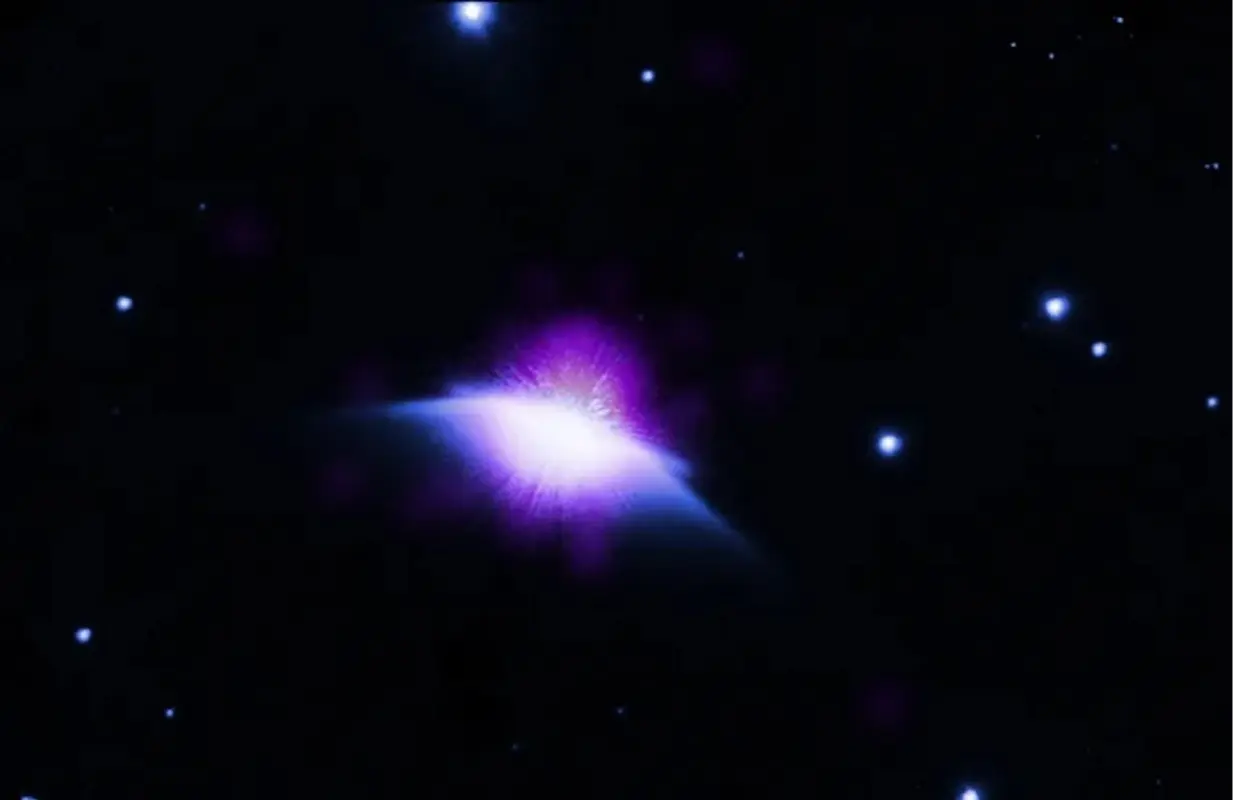
HD 61005 in X-ray and Infrared light. (Image via NASA)
NASA’s Chandra X-ray Observatory recorded the first clear image of an astrosphere surrounding a Sun-like star, HD 61005, located approximately 120 light-years from Earth, according to NASA on February 23, 2026.
HD 61005 has roughly the same mass and temperature as the Sun but is approximately 100 million years old.
Its strong stellar wind, traveling three times faster and twenty-five times denser than the solar wind, is inflating a bubble of hot gas as it expands into cooler interstellar gas and dust.
This observation provides a direct view of a process similar to that which shaped the early Sun’s heliosphere.
NASA Observes Astrosphere Encasing Young Star HD 61005
Formation and Structure of the Astrosphere
Astronomers study HD 61005 because its star-driven winds produce an astrosphere that extends into the neighboring interstellar medium.
The star resides inside a bubble, which contains hot gas, while the cooler galactic gas and dust move away from it.
Carey Lisse of Johns Hopkins University, who led the study published in the Astrophysical Journal, noted that this observation allows scientists to examine the shape of a Sun-like star’s protective bubble from an external perspective.
The astrosphere extends to a diameter that measures 200 times the distance between Earth and the Sun. Observations show slightly extended emission rather than a single point of light, as seen for other similar stars.
The interstellar medium forms a clear boundary, which X-ray imaging detects because HD 61005 wind activity increases the bubble size and pushes against it.
Observational Techniques and Data
Chandra’s X-ray capabilities allowed astronomers to detect HD 61005’s astrosphere, which produces X-rays as its strong stellar wind collides with surrounding dust and gas.
Early observations in 2014 provided brief hints of X-ray emission from the star. A follow-up observation in 2021, lasting nearly 19 hours, confirmed the extended structure of the bubble.
The combination of the star’s proximity, dense local interstellar environment, and Chandra’s high-resolution X-ray vision enabled the direct imaging of the astrosphere.
The dense local galactic environment, along with the star’s strong wind and proximity, strengthened the X-ray signal.
The observation captured the full extent of the bubble as it interacts with cooler surrounding gas and dust.
Infrared observations from NASA’s Hubble Space Telescope showed that HD 61005 is surrounded by large amounts of dust, forming patterns resembling moth wings.
This configuration led to the star system being nicknamed the “Moth.” The interstellar material around HD 61005 is roughly a thousand times denser than that surrounding the Sun.
Comparisons to the Sun and Implications
HD 61005’s stellar wind and astrosphere provide insight into the early conditions of the Sun.
Scott Wolk of the Center for Astrophysics | Harvard & Smithsonian explained that the solar wind affects Earth’s space environment and that observations of HD 61005 help characterize the Sun’s wind during its early evolution.
The Sun likely passed through similar dense regions of interstellar gas and dust, producing a heliosphere comparable to HD 61005’s astrosphere.
An artist’s illustration depicts a bow shock in front of the star, caused by the motion of the astrosphere through interstellar gas, which mirrors processes occurring around the Sun.
HD 61005 is not visible to the unaided eye but can be observed using binoculars.
The Chandra program is managed by NASA’s Marshall Space Flight Center, with science operations conducted by the Smithsonian Astrophysical Observatory’s Chandra X-ray Center in Cambridge, Massachusetts.
The astrosphere’s detection provides a direct view of a wind-blown bubble around a young Sun-like star.
Stay tuned for more updates.