

James Webb Space Telescope captures first published supernova progenitor detection
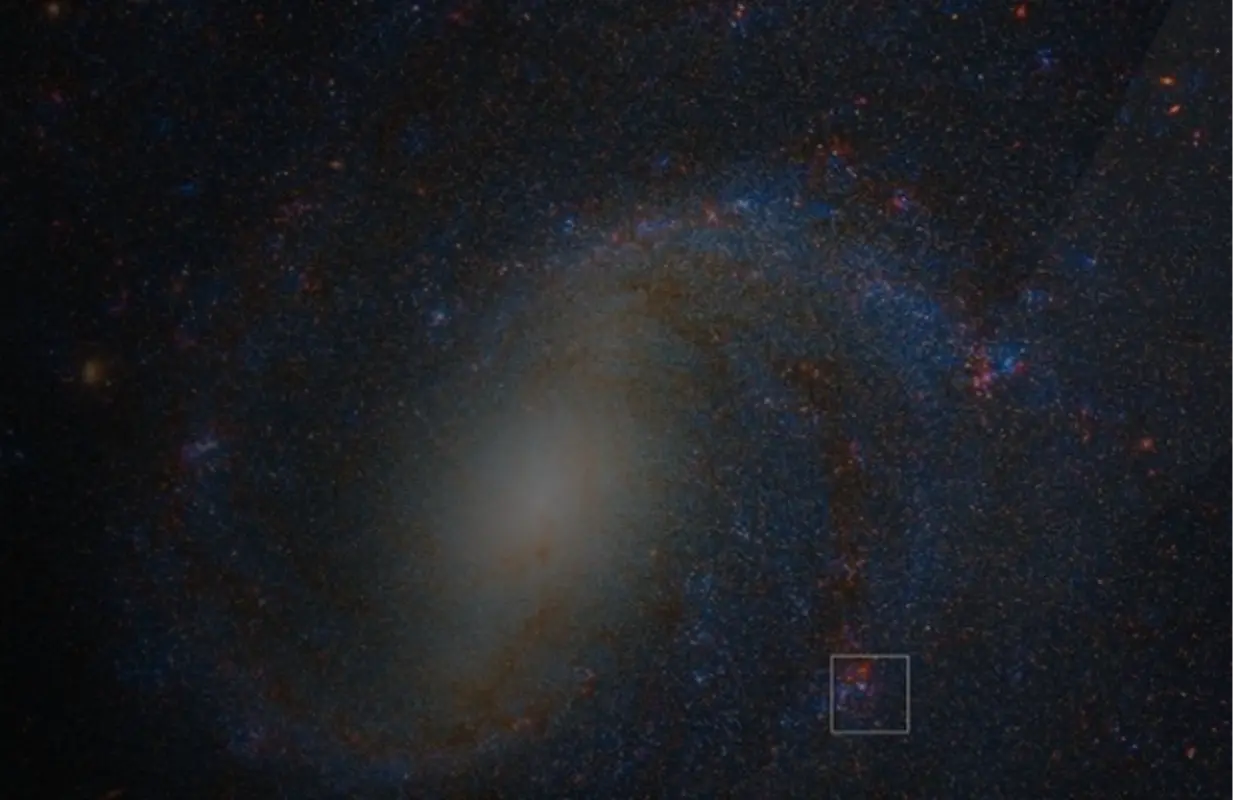
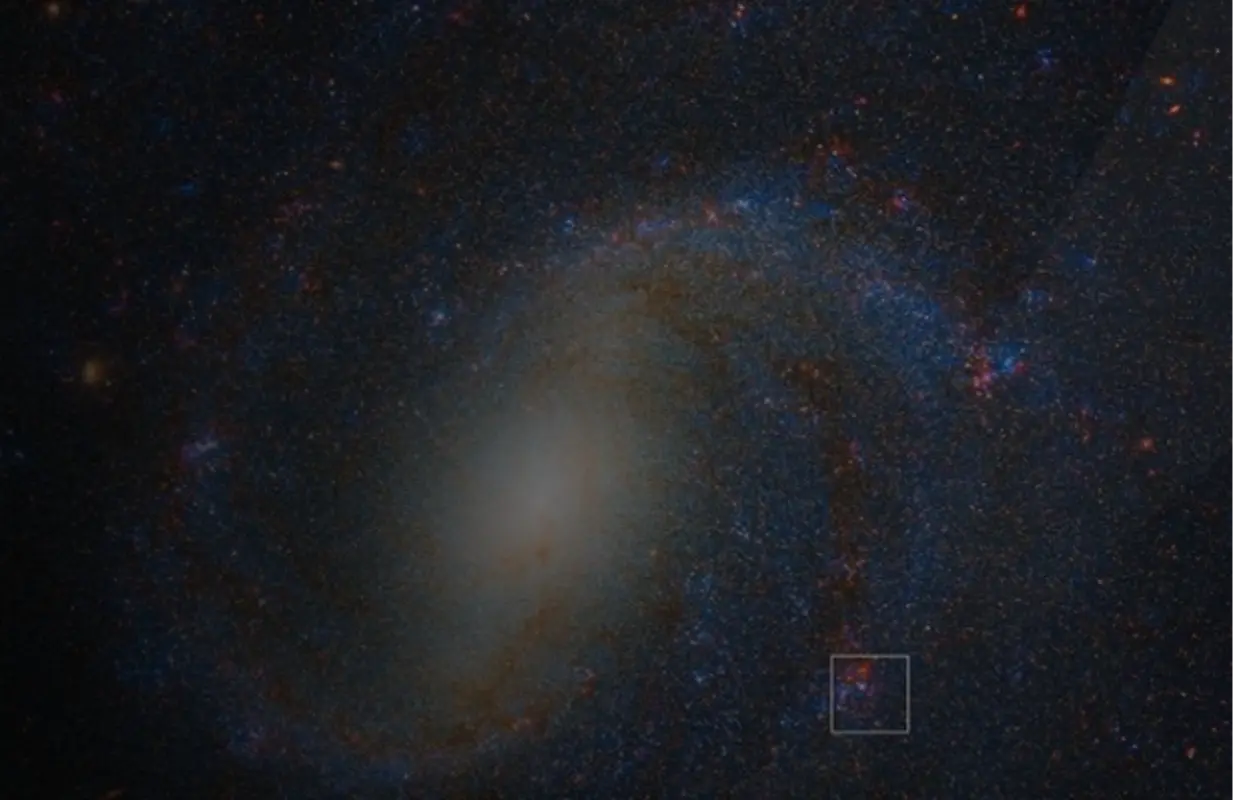
Image at left shows a combined Webb and Hubble view of spiral galaxy NGC 1637. (Image via NASA)
A star in the adjacent galaxy NGC 1637 exploded 40 million years ago and its light traveled through space until it reached Earth on June 29, 2025 which the All-Sky Automated Survey for Supernovae detected.
Scientists focused on this event, labeled SN 2025pht, using archived data to locate the progenitor star before its explosion.
NASA reported that images from the James Webb Space Telescope (JWST) revealed a red supergiant star at the location of the supernova, representing the first published detection of a supernova progenitor by Webb.
The Astrophysical Journal Letters documented this discovery which included data from Hubble and Webb.
James Webb Space Telescope Identifies First Supernova Progenitor
Detection Using Pre-Explosion Imaging
The research team used Hubble and JWST images of NGC 1637 to determine which star existed before the supernova event.
The star became visible to JWST when its Near-Infrared Camera and Mid-Infrared Instrument captured the 2024 footage, which Hubble failed to show before the supernova.
The star appeared red, which showed that dust particles surrounded it.
The star became less visible in shorter wavelengths because Aswin Suresh, a graduate student at Northwestern University, investigated the effect of dust on its visibility.
The research results help scientists discover the reasons why certain red supergiants remain hidden until their supernova explosions.
The team found that the progenitor had been consistently visible through JWST infrared data by examining multiple Hubble and Webb imaging times.
Researchers used Hubble post-explosion images together with Webb pre-explosion images to achieve exact measurements of the red supergiant location at the supernova site.
Dust Composition and Characteristics
Computer modeling of the JWST data indicated that the circumstellar dust around the progenitor star was carbon-rich. This finding differed from the expected silicate-rich composition.
NASA reported that the carbon could have been brought to the star’s surface shortly before it exploded. The mid-infrared capabilities of JWST were essential in determining the dust composition.
Observations from Hubble showed the supernova after the explosion, while JWST provided the pre-explosion images of the red supergiant star.
Implications for Future Observations
The team plans to identify similar red supergiants that could explode as supernovas. NASA stated that the upcoming Nancy Grace Roman Space Telescope could assist in this search.
Roman will have infrared sensitivity and resolution sufficient to detect such stars and monitor circumstellar dust variations.
The identification of SN 2025pht’s progenitor demonstrates the role of JWST in studying late-stage stellar evolution and pre-supernova characteristics.
Observations from Roman could allow astronomers to study variability in circumstellar dust ejection prior to explosions.
The JWST and Roman data together could help constrain the overall population of red supergiants that end their lives as Type II supernovae.
Spectroscopy and Type Classification
According to IOP Science, SN 2025pht was classified as a Type II supernova with broad hydrogen lines and minimal line-of-sight extinction.
The Hubble and JWST imaging results showed the progenitor star at wavelengths ranging from 0.8 to 8.7 microns.
The spectral energy distribution modeling proved that the star existed as a red supergiant which was completely hidden by surrounding circumstellar dust.
This research marks the first time JWST discovered a supernova progenitor which provides information about the star's dust and environmental conditions before its supernova event.
NASA operates the James Webb Space Telescope through a partnership with ESA and the Canadian Space Agency.
The telescope keeps supplying pre-explosion imaging and spectroscopic data which lets astronomers study progenitor stars in nearby galaxies to determine their characteristics before supernova events.
Stay tuned for more updates.