


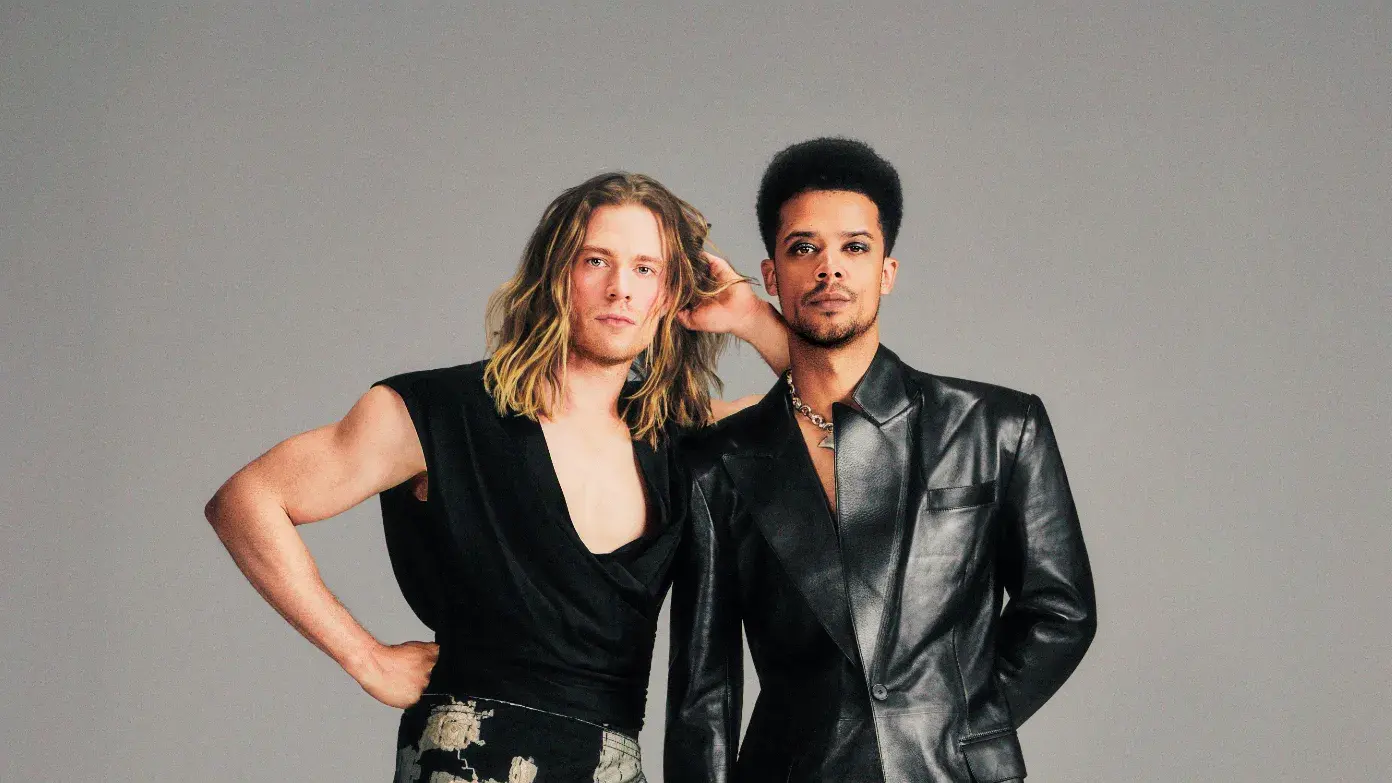
Sam Reid and Jacob Anderson have a habit of finishing each other’s sentences.
It’s a bright spring morning in New York, a few weeks ahead of the highly anticipated third season of their hit show Interview With the Vampire—officially retitled The Vampire Lestat—and we’re making our way down the Guggenheim Museum’s spiraling ramp. We stop in front of a looming, crumpled steel structure by Carol Bove, as Reid is reflecting on the show’s script.
“Just to reference the artwork—it feels a bit like this, where it looks very soft, sort of delicate,” he says, gesturing to the sculpture. “And then it’s obviously made from such a hard steel structure. It looks like it’s something that you want to eat and cuddle into, but you also know that it would be quite painful to touch and lean into it, like a—”
“Like a dagger,” Anderson supplies.
“Yeah,” agrees Reid. “It’s sort of amazing. You wouldn’t—”
“You wouldn’t want it to fall on you,” Anderson says.

ON ANDERSON: Jacket and Shirt by Versace. Pants by Versace. Belt by W.Kleinberg. ON REID: Vests by Dior. Pants by Celine. Belt by Kieselstein.
Meanwhile, when Anderson trails off toward the end of his sentences to gather his thoughts, Reid, as if reading his mind, supplies the words he was searching for (and asks follow-up questions so good I have half a mind to wonder if he’s angling for a side hustle in journalism).
They’re like this for the entirety of our time together: a pair so in sync that I’m not sure they’re even aware of it, the twins from The Shining if they were men in their 30s who don’t resemble each other at all. Reid, who portrays the vampire Lestat de Lioncourt, is slightly taller and a pillar of cool in his bomber jacket and sunglasses. His blond hair is tied back into a low knot that exposes tiny hoops hugging his earlobes, Lestat’s thick French accent gone in favor of Reid’s natural Australian speaking voice. Anderson, meanwhile, carries none of the ruthlessness but all of the swagger of his character, the vampire Louis de Pointe du Lac. He’s in a fuzzy olive fleece and graphic tee, darting this way and that through the museum with his Canon 310XL in-hand, all Britishisms and warm brown eyes instead of icy green contacts and a New Orleans drawl.
The pair move in tandem through the galleries with a lived-in, instinctive ease that only two people who have spent significant time with each other could. They’ve been a unit for half a decade now, shooting this Anne Rice adaptation that has turned into an unlikely sensation, with the two becoming, as Reid describes them, “best friends” along the way. (A much more wholesome relationship than that of their characters, two eternally complex, dependably toxic, in-love immortals.)
The Vampire Lestat, out June 7, marks a departure from the first two seasons: Tonally, it’s less of a gothic romance and more of a campy, glittery, sex-drugs-and-rock-and-roll-fueled whirlwind music documentary, with an expectant fan base as hyped as an actual screaming crowd at a concert.
Narratively, the perspective shifts from Louis to Lestat as the latter attempts to untangle the less-than-positive portrayal of him that was presented in the first two seasons, while also embarking on a career as a world-famous bloodsucking, 265-year-old rock star. As showrunner and producer Rolin Jones tells me of the way Anderson and Reid are juxtaposed onscreen this season, “One is in the front, and one is pushing behind. They’re both so selfless about it. And they’re a real support for each other. It’s very beautiful to watch.”
Their costar Eric Bogosian recalls already noticing their bond when he met Reid and Anderson during the first season. “Immediately, I was struck by how these two guys were behaving around each other,” he tells me, with all the matter-of-factness (but none of the snark) of his character, the journalist Daniel Molloy. “I’ve been around a lot of lead guys, starry guys, cute guys that are basically, ‘Everybody, look at me.’ Take all the oxygen out of the room when they come into the room. These two guys make room for each other, and they clearly love being around each other. I mean, I have two sons, so I know what brothers are like, and they were behaving like brothers.”

ON ANDERSON: Jacket and Shirt by Versace. Pants by Versace. Belt by W.Kleinberg. ON REID: Vests by Dior. Pants by Celine. Belt by Kieselstein.
Filming the show is no easy task. Playing vampires, they shoot mainly at night for months on end and have a “draining schedule,” as described by Jones (no pun intended). This is confirmed by Reid and Anderson themselves, who meet me with hearty laughs when I ask about how they spend their downtime.
“It’s the best, but it’s full-on,” says Anderson. “You don’t really get a lot of rest. And it’s dense writing, so you’re putting your whole body and brain into it.”
“We’re all hyperaware that it’s a dream job,” Reid adds. “You get to do everything that you could possibly ever want to do as an actor in one single show. It’s quite stressful with how fast we move and how much they want to do, but if you don’t pinch yourself every day and go, ‘Wow, how fun is this?’ then you’re wasting your time.”
The original Vampire Chronicles novels by Anne Rice have sold over 80 million copies, while the iconic 1994 film starring Hollywood juggernauts Tom Cruise and Brad Pitt grossed more than $200 million worldwide. The AMC TV show had, as showrunner and producer Rolin Jones tells it, much to live up to: “It was a remake of that thing from the ’90s, and the expectations are low.”
And yet his Interview With the Vampire exists entirely outside the formidable shadows of its predecessors, accumulating critical acclaim—and a passionate, ever-devoted fan base—on its own. It received a renewal for season two before season one was even out, expanding Rice’s first Vampire Chronicles novel into 15 episodes. Now, the series is ambitiously venturing into the first-ever onscreen adaptation of the second book, The Vampire Lestat. In doing so, it’s blowing up the formula it built its success on and taking bigger, gutsier, crazier swings, veering left of the stylistic choices that have made it so beloved, and layering in new stories in a wildly different tone.
“It’s quite joyful to be in the thing that does reinvent itself all the time, as actors,” says Reid. “It’s very joyful to be in a new show every season. You—”
“You get to play a slightly different character every time,” Anderson completes the thought.
When Sam Reid booked the role of Lestat de Lioncourt, he began making collages.
He had read Anne Rice’s The Vampire Chronicles series before the script for the show came across his desk, and when it was confirmed Reid would become the Brat Prince, he went back and reread them. Then he spent weeks cutting up old National Geographics, finding imagery that evoked the characters—old Venetian paintings, darker images of soldiers after war—and placing them together.
“I had stuck them all over my kitchen cabinets,” he tells me. “I think I was a crazy person, but I love collage.”
If you couldn’t tell from all the collaging and reading, 39-year-old Reid enjoys the simple life: being back home in Sydney with his partner and their dog, gardening, and going to local markets (again—not nearly as similar to his hedonistic character as some might imagine). He’s not new to period dramas and romances, but while shooting the first two seasons of Interview With the Vampire, he was also playing the male lead on something completely different, the Australian drama The Newsreader; right after The Vampire Lestat’s summer release, he’ll exchange Lestat’s tight leather pants for vestments, playing a priest in a stage production of Doubt: A Parable. He’s a chameleon, disappearing into roles with no trace of Sam Reid left behind.
This is the dedication he’s brought to Lestat de Lioncourt, culminating in a performance that’s maximally uninhibited and vulnerable in The Vampire Lestat. He vacillates expertly between sex-symbol rock god, egotistical immortal who refuses to say anything meaningful, and broken and traumatized man, delivering a heart-wrenching monologue in episode three about Lestat’s transformation into a vampire that marks one of Reid’s strongest scenes in the series so far.
“He’s always been messy,” Reid says about Lestat. “He’s flippant, he’s mercurial, he doesn’t want to get to the center of himself. Louis was trying to get to the center and trying to understand himself in a controlled way, whereas Lestat has no intention of working out who he is. He’s just chased by his own personal demons, and [The Vampire Lestat] is forcing him to acknowledge that.”

Shirt by Maison Margiela. Pants by Amiri. Necklaces by Patricia Von Musulin.
Although Reid has some musical-theater experience, the performances in The Vampire Lestat are a different sort of beast. To prepare, he learned how to play violin and guitar to an extent that would look convincing onscreen. He laid down vocals for an entire album’s worth of original songs, crafted by the show’s composer, Daniel Hart, who looked to the glam and excess of ’70s singer-songwriters. (Anne Rice, for her part, named Jim Morrison as inspiration.) For the concert scenes, Reid also performed live at Toronto venues. “You’ll be hard-pressed to see any other actor on television have to do the number of things that he has to do,” Jones says of Reid. “And do them so artfully. I will never have anybody like him again.”
The season is a “bold swing,” Reid says, more comedic than the first two seasons but darker too—which is what makes him both excited and nervous for people to see it. “Watching it is a ride,” he tells me. “It should be the kind of show that you stand up and scream at a TV or get really angry at, have a visceral reaction to.”
The online buzz for The Vampire Lestat has largely been about seeing Reid as this eyeliner-and-glitter-covered sensation, the wild vampire at his wildest self. But along with the excitement, there’s trepidation about how delicately—if delicately at all—the show will handle themes of grooming, incest, and sexual assault in relation to Lestat’s mother, Gabriella (Jennifer Ehle). In the books, where she’s known as Gabrielle, she’s turned into a vampire by Lestat on her deathbed, then abandons him to travel the world, appearing again after decades apart.
“Incest is not something that anybody wants to explore, but you really understand the character Lestat through it,” says Reid. “And there is a very large payoff with that storyline. And I think it’s really important, because even though the show is fun, it is a comedy, and it is sort of silly in a way, it also deals with some pretty intense things.”
Anderson adds, “So much of this story as an overall thing is about abuse and the ramifications and echoes of abuse across—”
“Centuries,” says Reid.
“Generations,” Anderson agrees.
It’s a season that holds up a mirror to the uglier truths of our vampiric friends’ long, long lives. In seasons one and two, Louis struggled with recalling certain events for the gruesome realities that they were, and instead delivered cleaner, sugarcoated versions in his retelling; The Vampire Lestat slaps the viewer in the face with the brutal truth, again and again and again.
“They are actually really fucked-up characters that are greatly loved by people but also capable of eating babies, slaughtering their best friends,” says Reid. “You shouldn’t be rooting for them, and we can’t control how people feel about them. All we can do is just play the roles as they’re written in the script and serve them as best as we can.”

Clothing and sunglasses by Saint Laurent by Anthony Vaccarello. Boots by Enfants Riches Deprimes. Earrings (throughout), his own.
As the Guggenheim starts filling up with visitors, Reid, Anderson, and I head a couple of blocks south for a quiet coffee at Cafe Sabarsky. Its gilded decor could easily fit into the opulent New Orleans town house from Interview With a Vampire season one; when we enter, Reid raises his brows and remarks, “Fancy.”
Reid takes his coffee iced, with just a splash of cream, while Anderson—who typically drinks his with so much milk and sugar that, on set, he says, “The crafty guys called it ‘milky Splenda’”—opts for a double espresso. Even before the coffee, Anderson, 35, is already sprightly, looking forward to heading back home to England to see his wife and two young daughters again. He’s also eager to get back into a creative routine: watching movies (last year, he estimates he saw around 250), tinkering with his forthcoming third album, gearing up to drop the film projects he’s spent most of this year working on.
While in New York, though, he’s running uptown and downtown for The Vampire Lestat promotion. Anderson is no stranger to the press responsibilities that accompany TV shows with mega-fandoms—if you didn’t catch him in season 13 of Doctor Who, you probably remember him as Grey Worm on Game of Thrones.
When the opportunity for IWTV came across his desk in 2021, Anderson was at an impasse. He had released two rap-R&B albums and a handful of singles under the stage name Raleigh Ritchie (a combination of his two favorite character names from Wes Anderson’s The Royal Tenenbaums). There were “hang-ups from my former life in acting,” is how he puts it, and he wasn’t sure if it was his calling anymore. Nothing he read seemed to be clicking.
Then he got the Interview With the Vampire script.
“When I read it, I was like, This is the thing,” he says.

Shirt, tie, and sunglasses by Saint Laurent by Anthony Vaccarello. Jeans by Kenzo. Boots by Giuseppe Zanotti. Bolo tie, stylist's own by Southwest Skies from Montana Silversmiths. Ring (on left hand, thoughout) his own.
Anderson suddenly went from not knowing if he was going to continue acting to wanting the part of Louis so bad that he nearly cracked under the pressure of it. “It started to mean too much to me,” he says.
Though he thought that he whiffed his first Zoom reading with Reid, his castmate disagrees: “I mean, it was never a question that it was going to be Jacob.”
“He called me [after getting cast] and he asked me, ‘How do you like to work? And do you mind if I play music in the trailer?’” Reid continues. “I thought, What a gracious person. I’d never had anybody call me before and ask me how I want to work. I mean, I started sending him selfies of myself, which is a kind of unprecedented thing for me to do.”
Delainey Hayles, who joined the cast as Claudia in season two and is returning for season three, also quickly bonded with Anderson. “Working with Jacob, it was like I had a big brother on set and he was helping me in some difficult scenes,” she says. “He was kind of like the light at the end of the tunnel in some moments where I’m like, ‘I don’t know how this is, I don’t know how I’m going to do this. I’m new.’ And he’s like, ‘None of that matters. You’re Claudia. Go be Claudia.’”
Anderson is the first Black actor to portray Louis, who’s written in the books and movie as a white 18th-century Louisiana plantation owner; the AMC show is also the first adaptation in which the romantic relationship between Louis and Lestat is explicitly stated. In the television adaptation, Louis’s race and sexuality inextricably inform the way he moves through the world across decades; his story becomes that of a man who was battling prejudice on the margins of mainstream society well before he was turned into a vampire. For Anderson, one of the joys of playing Louis comes from the fact that he’s allowed to be as nuanced and messy and antagonistic as any white character on the show, or any white Louis from past adaptations.
“The myth of representation is that all representation should be good representation,” he says. “I think one of the exciting things about this show is that [non-white characters] Louis and Claudia and Armand are imperfect characters. They are incredibly rich characters and there is space to explore how problematic they are but also how beautiful and elegant and wonderful they are, but they don’t always have to make the right decisions. I think that’s something to celebrate. And it’s not something that’s that easy to come by now, particularly at the moment. I feel like some of that’s backtracked in the industry, generally.”
In Rice’s novels, Louis’s story is mostly contained to the first book, which spans seasons one and two of the show. But for Rolin Jones, the idea of Anderson not being in the third season—or even having a diminished role—was out of the question: “He’s too good of an actor, no matter how little there is in this book.”
Anderson, however, was a little more ready to let Louis go. “I felt like there was such a satisfying sense of closure for Louis at the end of season two,” he says. “I couldn’t really get my head around what else we need from him in the story. What I, Jacob, wanted for him, was for peace. I wanted him to garden.”
Even at the cost of you, Jacob, being sidelined or written out?
“It’s so hard for me to relent to something if I don’t understand it, if I’m not into it,” Anderson explains. “I had to really understand what the purpose was of Louis coming back.”
He was eventually convinced over discussions with Jones and co–executive producer and writer Hannah Moscovitch about what an original, noncanonical plotline for Louis would look like. Jones was uninterested in the “flat line” of going back to Louis’s guilt over Claudia’s death, choosing instead to “go deeper and screw up Louis more, with our destination of actually trying to, in theory, bring ‘Loustat’ back together.”
Ultimately, the journey wasn’t just a transformational one for Louis but for Anderson too. “I think Louis has really given me some confidence back and a surer sense of myself than I had before,” says Anderson. “I’m really moved by how he is constantly on this relentless mission to figure himself out, and I think that that’s my mission too.”

Jacket, shirt, and bow tie by Dior. Jeans by Celine. Belt by Burberry. Ring by The Great Frog.
Despite the premiere of Interview With the Vampire driving an unprecedented number of subscriptions to AMC+ and once ranking among the top 2.7% of television shows after its recent addition to the more mainstream streaming platform of Netflix, my first exposure to the show came from the fans themselves. All over my feeds, I was inundated with fancams and fan art and even a hand-painted Lestat and Louis purse. When I ask Reid and Anderson about all the art and discourse spawned by the show, the former answers, “I think it is sort of extraordinary, that it can generate a form of critical thinking, that it can generate a passion for art, and that’s beautiful.”
“Why should we ruin it for them by being online?” says Anderson.
Although, if you’re wondering if they’ve seen what fans are saying about them on the internet—they have. No one is immune to the allure of the occasional scroll.
“I think something I’ve learned recently is, it’s none of my business,” says Anderson. “And you don’t want affect the way that you—”
“Do your job, yeah,” says Reid.
“Do your job and live your life,” Anderson agrees. “Seeing some takes and perceptions of us, all of us, I’m like, ‘Oh, that’s interesting. That’s your version of a person, rather than the actual people.’ But also, it’s not for me to take that away from them.”
“We do the show, and I think the show’s enough,” Reid adds. “I think the show generates enough things, and once every couple of years we do loads of interviews and give them heaps of YouTube videos to edit and make a meme out of it. We’re about to go and read thirst tweets after this."
As far as the future of the show goes, Reid and Anderson can’t say much about their individual contracts. While the series isn’t yet renewed for a fourth season, they’re still hopeful for more. “We talk about it all the time,” says Reid. “We think about it all the time.”
One thing that Reid speculates could be coming next is a main female perspective, if the next novel to be adapted is Rice’s The Queen of the Damned (which also became the 2002 cult-favorite movie of the same name, starring the late Aaliyah). That story follows Akasha, an ancient queen who became the world’s first—and most powerful—vampire, who’s been asleep for thousands of years. Lestat’s music awakens her in The Vampire Lestat and she’s slated to appear later in this season, portrayed by the actress Sheila Atim.
“Gabriella and Claudia are obviously incredible characters, but it’s been very male heavy,” Reid concedes.
“There’s something that feels very inevitable about what should be coming next,” says Anderson. “All these men need to—”
“Akasha has a patricidal ambition that I think is very pertinent to today—we have a lot of men in power that are single-handedly destroying the world,” Reid jumps in.
“And, just carrying on with utter fuckery,” says Anderson.

Shirt by Maison Margiela. Pants by Amiri. Necklaces by Patricia Von Musulin.

Clothing by Givenchy by Sarh Burton. Boots by Maison Margiela. Necklace by Patricia Von Musulin.
“It just couldn’t come at a more important time, I think, to say, what if we just removed them all? What if all the men left?” Reid concludes.
Anderson and Reid, despite the hundreds of thousands of edits and tweets and the sold-out fan events, still feel like the show is niche interest—a well-kept, if-you-know-you-know secret in the grand scheme of all the television shows populating streaming services right now. For them, the point isn’t ratings and numbers. It’s people resonating with the story.
“I feel pretty certain that people will find this show for a long time,” says Anderson. “And that’s what most people hope for.”
It’s a fittingly vampiric sentiment—the hope of this little show’s staying power in culture, its relevance for future generations to come. It’s not just love. It’s a love that lasts forever.
PRODUCTION CREDITS:
Styling by Max Weinstein
Grooming by Melissa DeZarate
Tailoring by Ksenia Golub