


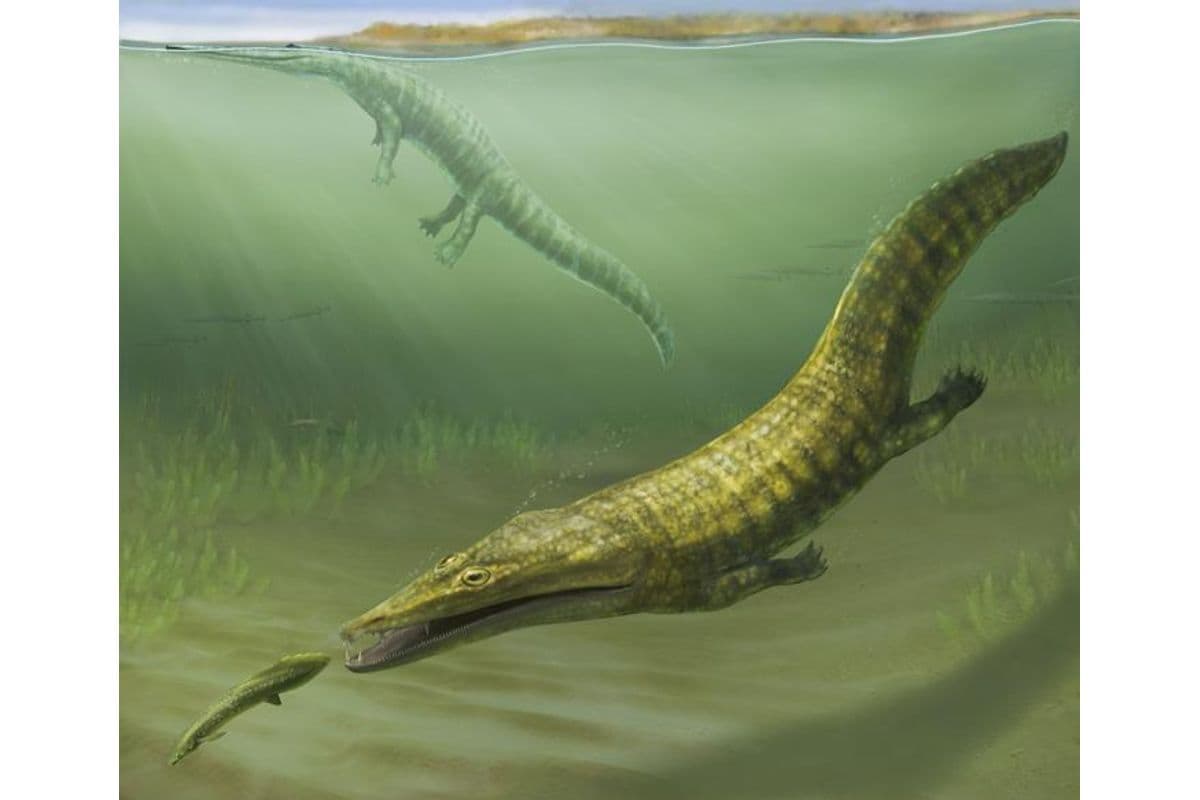
Less than a million years after Earth’s worst mass extinction, crocodile-like amphibians were already moving through coastal waters around the world. Fossils from Western Australia, originally thought to represent a single species, tell a different story. A new reexamination shows the skull fragments belong to at least two distinct trematosaurids — evidence that early marine predators had already diversified and begun spreading along ancient shorelines at the dawn of the Age of Dinosaurs.
The study, published in the Journal of Vertebrate Paleontology, revisits 250-million-year-old remains from the Kimberley region of northwestern Australia. The material adds Southern Hemisphere evidence to a fossil record shaped largely by discoveries in the north.
Read More: This 215-Million-Year-Old Crocodile Was Built to Run, Not Swim
Triassic Marine Amphibian Fossils Reexamined
Researchers first collected the amphibian remains during expeditions in the 1960s and 1970s from outcrops on Noonkanbah cattle station. In 1972, scientists described them as a single species, Erythrobatrachus noonkanbahensis, based on several skull fragments weathering from the rock.
Over time, the original fossils were misplaced and scattered across museum collections in Australia and the U.S. Without the full material in one place, the original interpretation remained untested.
That changed in 2024, when researchers tracked the fossils down and reassessed them using 3D imaging. By comparing differences in skull shape and bone structure, they realized the fragments did not all belong to the same animal.
Instead, they represented two trematosaurids: Erythrobatrachus and another species belonging to the genus Aphaneramma, a group already known from other parts of the world.
That shift shows early marine predator communities were already structured and differentiated, not dominated by a single generalized species.
Marine Predators in a Rebuilding Ocean
These amphibians lived shortly after the end-Permian mass extinction about 252 million years ago, an event that wiped out the majority of marine species and reset global ecosystems.
The early Triassic seas they inhabited were unstable. Ocean chemistry fluctuated, global temperatures were high, and food webs were still forming. Yet within less than a million years, marine tetrapods had already established themselves as top predators.
Trematosaurids were crocodile-like relatives of modern frogs and salamanders that could grow to over six feet long. They are the oldest clearly identifiable marine tetrapods of the Mesozoic era, appearing in the fossil record remarkably soon after the extinction.
The new imaging suggests that Erythrobatrachus had a broad skull about 40 centimeters long, consistent with a powerful predator. Aphaneramma, by contrast, had a long, narrow snout better suited for snapping up smaller, faster prey.
Both likely swam through the same coastal waters, but they were not hunting the same prey. That contrast shows predator roles were already dividing, even as marine ecosystems were still recovering.
A Rapid and Global Radiation
While Erythrobatrachus is currently known only from the Kimberley fossils, Aphaneramma has been documented in similarly aged deposits in Svalbard, Pakistan, Madagascar, and the Russian Far East. During the early Triassic, these regions were positioned along interconnected coastlines of ancient supercontinents, creating potential migration corridors.
That distribution suggests these amphibians were spreading along connected shorelines rather than remaining confined to a single region.
Until now, most evidence for this early marine radiation came from Northern Hemisphere sites. The Australian fossils extend that picture southward, showing that the recovery and expansion of marine predators was global.
The revised material indicates that early marine amphibians diversified quickly and adopted specialized feeding strategies, reshaping coastal ecosystems far sooner after the extinction than once thought.
Read More: Ancient Crocodile Fossil from Egyptian Desert Rewrites One of Earth's Greatest Survival Stories
Article Sources
Our writers at Discovermagazine.com use peer-reviewed studies and high-quality sources for our articles, and our editors review for scientific accuracy and editorial standards. Review the sources used below for this article:
- This article references information from a recent study published in the Journal of Vertebrate Paleontology: Revision of the trematosaurid Erythrobatrachus noonkanbahensis confirms a cryptic marine temnospondyl community from the Lower Triassic of Western Australia