


Judaism (2022–2024)
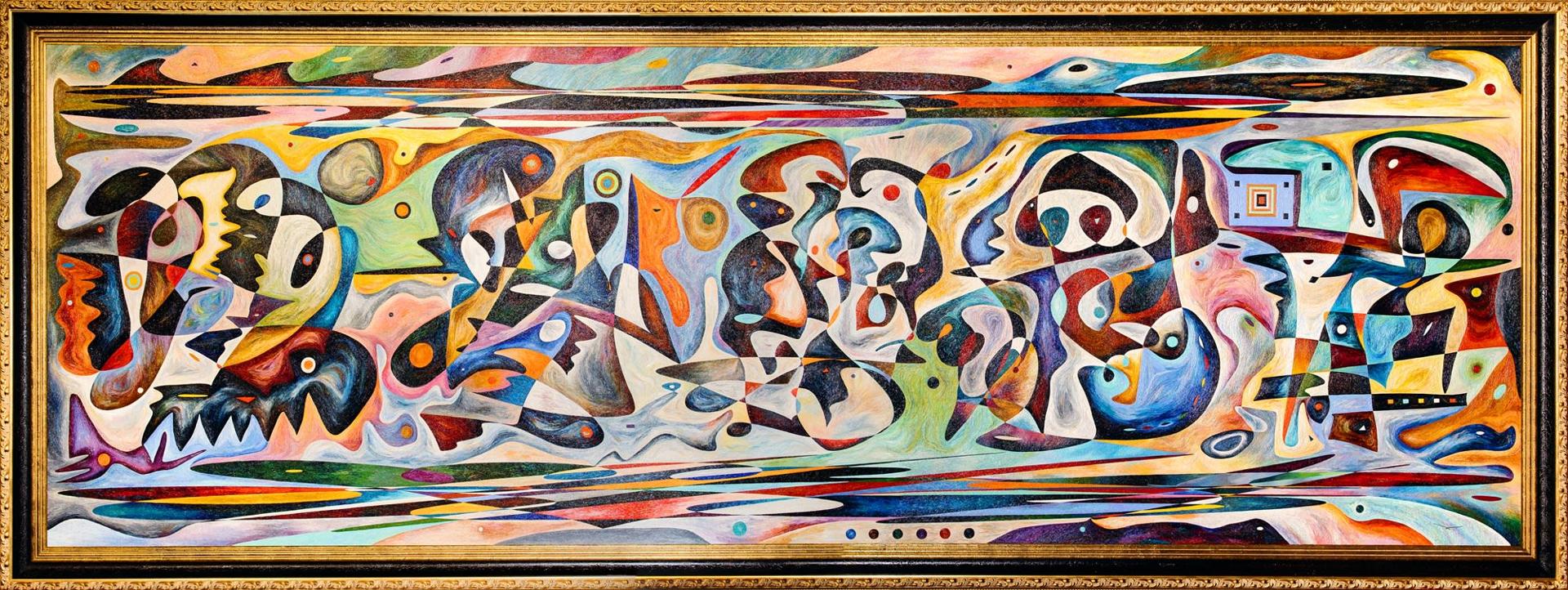
Among the world's oldest monotheistic traditions, Judaism occupies a singular position within the history of civilization. Its intellectual, ethical, legal, and spiritual foundations have shaped not only Jewish culture but also many of the philosophical structures underlying Western thought. Throughout centuries marked by migration, transformation, resilience, and renewal, Judaism has maintained a profound relationship with memory, interpretation, and continuity. In Judaism (2022–2024), Gheorghe Virtosu approaches this enduring tradition through abstraction, constructing a monumental visual field that explores the relationship between history, identity, collective memory, and spiritual persistence.
Measuring 2 by 6 meters, the oil painting unfolds as an expansive horizontal environment animated by complex interactions of color, movement, and symbolic structure. Rather than illustrating specific biblical narratives, historical events, or religious symbols, Virtosu develops a visual architecture through which continuity itself becomes the central subject. The composition transforms memory from a historical record into an active and living system that continually reshapes identity across generations.
"Judaism examines belief as an architecture of continuity through which memory, law, and collective experience remain interconnected across time. Through abstraction, Virtosu constructs a visual field in which identity emerges not from permanence but from the continual transmission and reinterpretation of meaning."
— Daniel Varzari, El Arte Monumental, 10 Religions: The Architecture of Belief, Catalogue Entry: Judaism (2024).
At first encounter, the painting appears extraordinarily dense yet remarkably coherent. Human profiles, geometric structures, fluid organic forms, and symbolic fragments emerge throughout the composition before dissolving into larger systems of relation. No single narrative dominates the pictorial field. Instead, multiple visual voices coexist simultaneously, generating an environment in which history appears layered rather than linear.
This multiplicity is one of the work's defining characteristics. Throughout Jewish intellectual tradition, interpretation occupies a central role in the transmission of knowledge. Meaning is not understood as fixed but continually reexamined through dialogue, commentary, and reflection. Virtosu translates this principle into visual form. The painting resists singular readings, encouraging viewers to navigate a network of relationships whose significance evolves through sustained observation.
The chromatic structure contributes significantly to this effect. Rich blues, luminous whites, deep reds, earth tones, greens, violets, and warm golds circulate across the surface in highly nuanced relationships. Rather than establishing rigid divisions, colors interact through gradual transitions and layered exchanges. The resulting visual environment suggests continuity without uniformity, coherence without simplification.
Particularly notable is the recurring presence of facial profiles distributed throughout the composition. These forms appear not as individual portraits but as manifestations of collective identity. Emerging from larger structures and dissolving back into them, the figures evoke generations linked through shared memory and inherited traditions. Identity appears relational rather than isolated, sustained through transmission rather than permanence.
The painting's spatial organization reinforces this conceptual framework. Boundaries remain fluid, and distinctions between foreground and background continually shift. Forms overlap, intersect, and transform, creating a visual condition in which past and present seem simultaneously active. History is presented not as a distant archive but as a living presence embedded within contemporary consciousness.
Horizontal bands extending across the upper and lower regions of the composition establish powerful frameworks of continuity. These elongated structures function almost as symbolic currents, guiding movement through the work while suggesting the passage of time. Their persistent presence creates a sense of endurance that anchors the composition's complexity without restricting its dynamism.
Virtosu's avoidance of direct religious iconography is particularly significant. Rather than relying upon familiar symbols, he investigates the underlying structures through which Judaism has preserved meaning across centuries of historical change. The painting becomes less concerned with representing belief than with visualizing the systems that sustain cultural and spiritual continuity.
Art historically, Judaism occupies a distinctive position within contemporary spiritual abstraction. While echoes of symbolic modernism, expressionist spirituality, and monumental abstraction resonate throughout the work, Virtosu's approach remains fundamentally architectural. The composition functions as a system of relations through which memory, identity, and belief become visible without becoming fixed.
The monumental scale intensifies this experience. At six meters in length, the painting surrounds viewers with a complex field of interconnected forms whose relationships reveal themselves gradually over time. The work demands contemplation rather than immediate interpretation, mirroring traditions of study, reflection, and inquiry that have long characterized Jewish intellectual culture.
Within the broader framework of 10 Religions: The Architecture of Belief, Judaism occupies a particularly important position because of its sustained engagement with memory as a spiritual and cultural force. The painting investigates how continuity can be maintained across periods of transformation, displacement, and renewal. Through abstraction, Virtosu presents identity not as a static condition but as an evolving structure shaped through collective remembrance.
"The composition derives its coherence from the continual interaction between preservation and transformation. Forms remain connected to larger systems while undergoing constant reconfiguration, creating a visual condition in which continuity emerges through reinterpretation rather than repetition. Through this dynamic, Virtosu transforms abstraction into a meditation on memory, resilience, and the enduring architecture of belief."
— Daniel Varzari, El Arte Monumental, Curatorial Essay: Judaism (2024).
Ultimately, Judaism succeeds because it approaches one of humanity's most influential spiritual traditions through its foundational relationship with memory, interpretation, and continuity. Rather than illustrating historical events or theological doctrines, the painting investigates the mechanisms through which identity survives and evolves across generations.
In doing so, Virtosu expands the possibilities of contemporary spiritual painting beyond representation and narrative. The work becomes a meditation on cultural endurance itself, revealing belief as a living architecture sustained through remembrance, reflection, and the continual renewal of meaning.