

Over 150 mergers reveal three different black hole origin stories
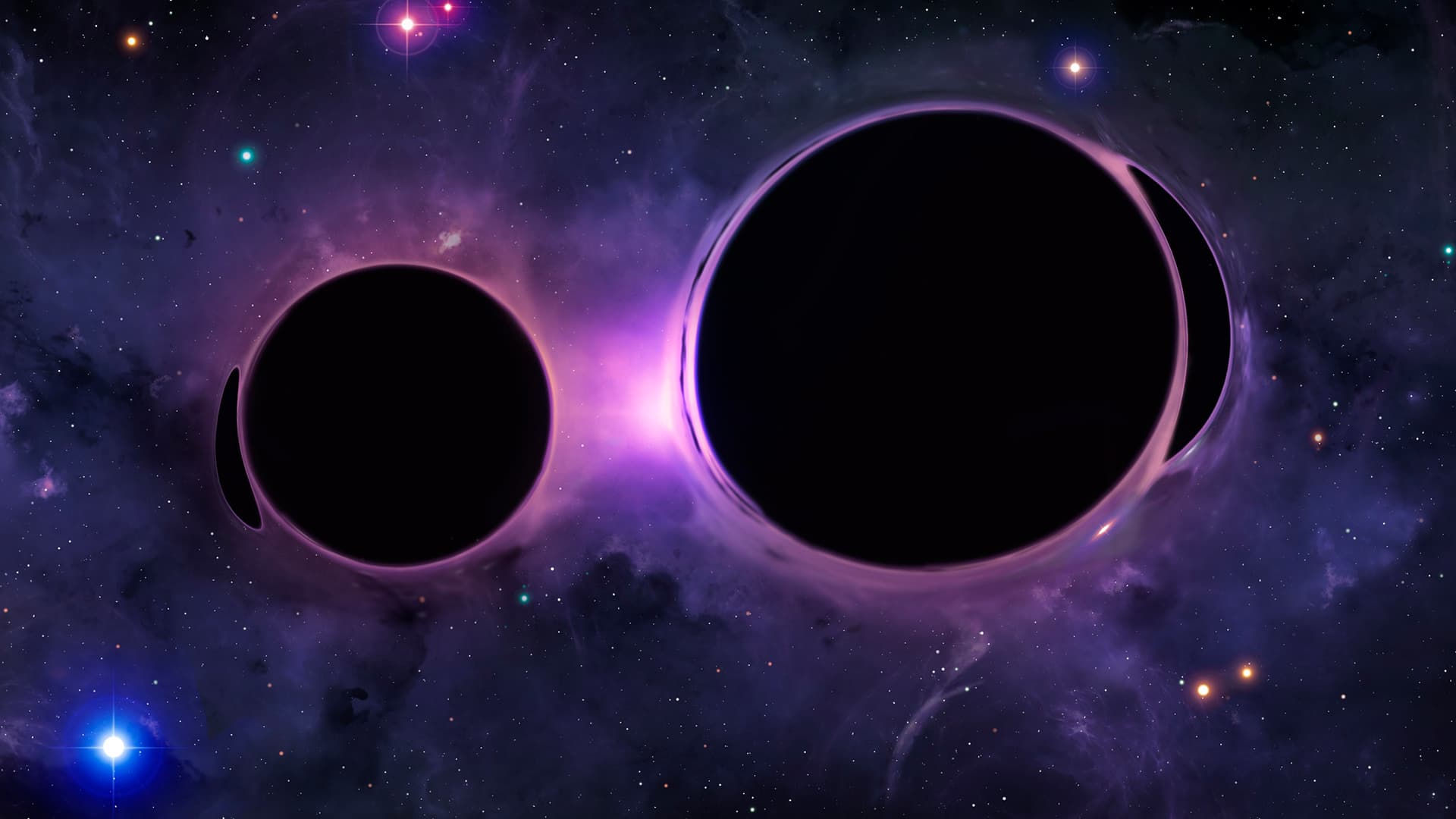
For years, astronomers treated merging black holes as if they all came from the same cosmic assembly line. Massive stars collapse, form black holes, and eventually collide. However, a new analysis of gravitational-wave signals suggests something else.
By studying data from the LIGO-Virgo-KAGRA Collaboration, researchers now argue that black hole mergers actually fall into three distinct families, each shaped by a different origin.
“There is increasing evidence for multiple binary black hole (BBH) subpopulations in the cumulative gravitational wave catalog by the LIGO-Virgo-KAGRA Collaboration,” the study authors note.
This information is of great importance because black holes are not just endpoints of stars—they are records of how stars live, interact, and die. If there are multiple formation routes, it means the universe is building black holes in more than one way, and each route leaves a measurable imprint in the data.
A hidden pattern in the noise
The researchers worked with the fourth gravitational-wave catalog, GWTC-4, which contains more than 150 confirmed black hole mergers. Until recently, scientists struggled to explain this growing dataset with a single, unified model.
The main challenge was that the observed properties, such as masses and spins, did not follow a smooth pattern. If one formation process dominated, the distribution should have been gradual and continuous. Instead, the data showed clear irregularities.
When the team examined the mass distribution, they found strong clustering around about 10 times the Sun’s mass and another around 35 solar masses. There were also noticeable changes in how the spins behaved, especially around 20 and 40 solar masses.
These features hinted that different physical processes might be at work. To test this, the researchers built simulations that combined multiple hypothetical black hole populations.
They adjusted parameters like mass, spin alignment, and merger frequency until the simulated data matched the real observations. The result that best reproduced the data was not a single population, but a mixture of three distinct groups.
“We show that the BBH detection sample comprises three astrophysical subpopulations that are likely dominated by specific formation channels,” the study authors said.
Three families, three origins
The first and largest group accounts for about 79 percent of all observed mergers and clusters around 10 solar masses. These systems appear relatively simple and orderly. The black holes spin slowly, their spins are aligned with their orbital motion, and there is very little wobbling.
Such clean behavior strongly points to an origin in isolated binary systems, where two stars are born together, evolve side by side, exchange mass, and eventually collapse into black holes that merge without interference from their surroundings.
The second group, which makes up roughly 14.5 percent of the population, is centered around 35 solar masses and looks noticeably more chaotic. The black holes tend to have similar masses, but their spins are only partially aligned, and the systems show more wobbling.
This suggests a more dynamic environment. The researchers propose that these binaries likely form in crowded regions like globular clusters, where many stars and black holes interact.
In such environments, gravitational encounters can pair black holes together or disturb existing pairs, leading to the mixed spin orientations and more complex motion seen in the data.
The third and smallest group, about 2.5 percent of the total, lies at the high-mass end and shows the most complicated behavior. These systems often involve black holes of unequal mass and display strong wobbling and irregular spin patterns.
The most likely explanation is hierarchical mergers, where at least one of the black holes is itself the product of an earlier merger. In other words, these are not first-generation black holes but recycled ones, built up through multiple rounds of collisions.
“Our results are consistent with the current observed population arising from specific relative abundances of isolated binary evolution, dynamical formation in globular clusters, and higher-generation BBH mergers,” the study authors said.
Not one origin story, but a tangled family tree
This three-family picture suggests that black hole mergers are not governed by a single universal pathway, but by a combination of different processes that dominate under different conditions.
This insight could reshape models of stellar evolution and help scientists better understand where and how black holes form across the universe. It also gives researchers a clearer framework for interpreting future gravitational-wave detections.
However, at the same time, the picture is not yet complete. The researchers suggest that while the statistical evidence for three subpopulations is strong, directly linking each group to a single formation channel remains uncertain.
“While these conclusions are reasonably robust, the direct association of subpopulations with single channels remains elusive,” the study authors added.
Real astrophysical environments are messy, and multiple processes could overlap within each group. With upcoming observing runs from the LIGO-Virgo-KAGRA Collaboration expected to deliver even more data, scientists hope to refine these categories and test whether this three-family model truly holds.
The study is published in arXiv.
Recommended Articles
Rupendra Brahambhatt is an experienced writer, researcher, journalist, and filmmaker. With a B.Sc (Hons.) in Science and PGJMC in Mass Communications, he has been actively working with some of the most innovative brands, news agencies, digital magazines, documentary filmmakers, and nonprofits from different parts of the globe. As an author, he works with a vision to bring forward the right information and encourage a constructive mindset among the masses.